
For Social Security Disability Attorneys
Never prep a case alone.
Lionize writes your chronologies, briefs, and audits from the entire record — then works the case with you.
Your case's author
Meet Leo
Leo reads every page of the record to write your documents — then works the case with you. An assistant that reasons like an attorney and a treating physician at once.
Ask things like:
- ·“Why did you choose Listing 1.15 over 1.18?”
- ·“What are the weakest points in this case?”
- ·“If the ALJ finds she can do light work, do the Grids still direct disabled?”
- ·“Summarize Dr. Rivera's treatment notes.”
 Leo
LeoI'm Leo — I wrote this brief. Ask me anything about it.
What's the strongest medical evidence that she can't sustain full-time work?
It's the combination, and it's all objective. The three findings that carry the most weight:
| Objective finding | Why it matters |
|---|---|
| Daytime hypersomnolence; STOP-BANG 6 (sleep study, Ex. 16F) | Unscheduled naps and off-task time no full-time job allows |
| TSH 51 → 40.5 → 24.8, severely uncontrolled (labs, Ex. 6F) | An objective driver of the profound, persistent fatigue |
| Moderate-to-marked limits in concentration & pace (psych eval, Ex. 12F) | Can't hold the pace competitive work requires |
Separately, the agency wrote each one off. Together — a sedentary physical base, further eroded by off-task time — they put full-time work out of reach. That combined-effect argument is the spine of the brief.
Editing
Revise the brief, with the author
Collaborate with Leo right in the brief — ask a question, request a change, explore a different argument. You're in control.
The exertional ceiling is sedentary, and the credited limitations erode even that base below competitive employment.
The reconsideration RFC of “light” deserves little weight: it raised the claimant’s exertional capacity above the initial sedentary finding even as the objective record worsened.
Properly credited, these limitations compel a residual functional capacity below the full range of sedentary work.
LeoAnalysis
The strategy behind every argument
Every document comes with the reasoning behind it — what was argued, what was set aside, and where you're exposed, so you see the weak points before the ALJ does.
Disability Analysis
Prepared for the hearing attorney
Theory of the case
A younger individual throughout the insured period — so the Grids direct “not disabled” at sedentary and light alike. The case turns on eroding the occupational base with non-exertional limits, proven by the combination of impairments, not any one alone.
Strengths
| Finding | Where it's proven |
|---|---|
| Antalgic gait, positive straight-leg raise, unable to squat | DDS exam — Ex. 13F p. 2 |
| Class III morbid obesity, 329 → 381 lbs | Treatment records — Ex. 16F |
| Lumbar facet arthropathy, L4–L5 / L5–S1 | Imaging — Ex. 13F p. 7 |
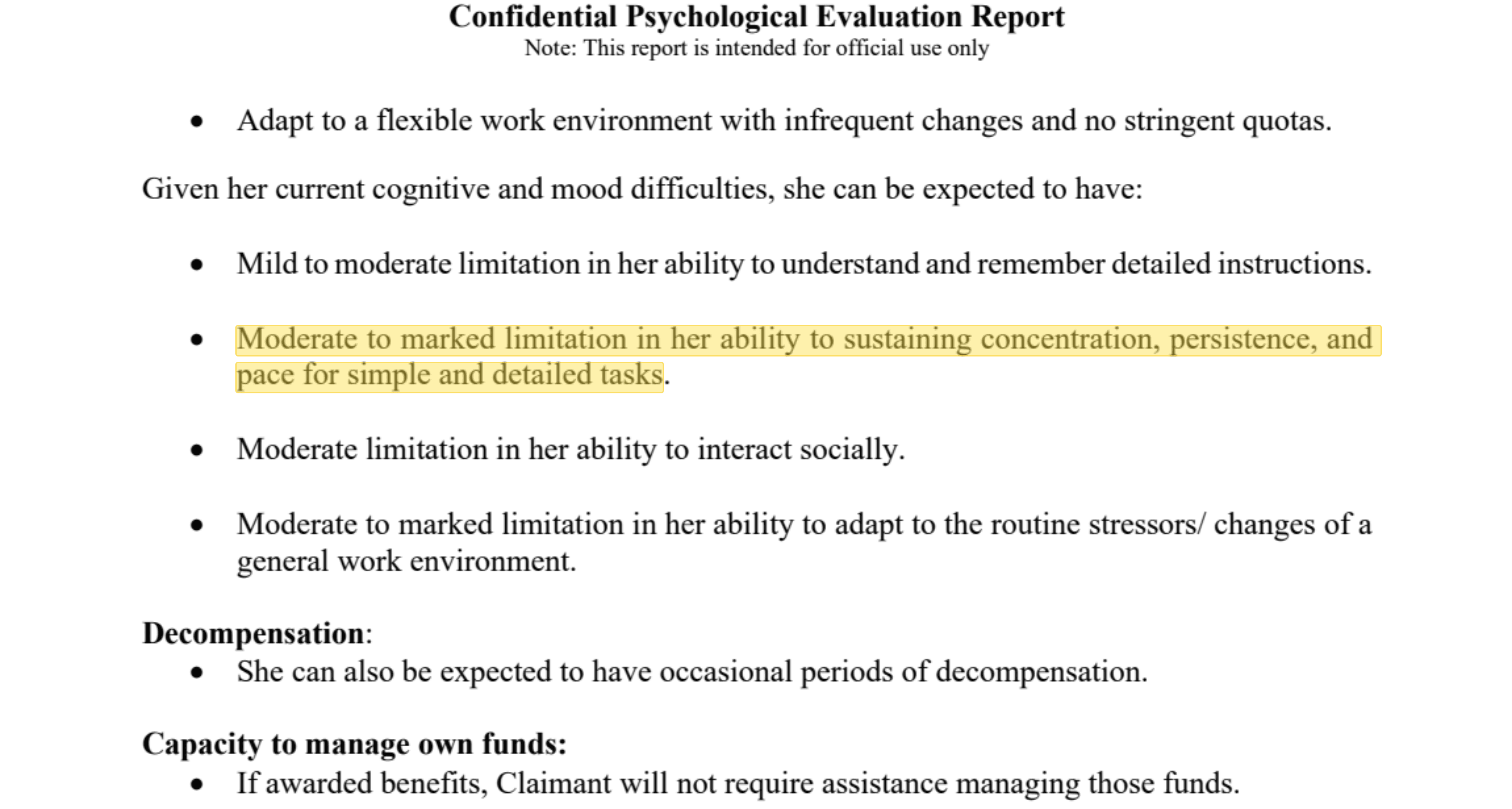
Citations
Click any citation. See the page.
Every fact is cited to the exhibit and page it came from, with the relevant passage highlighted right on the record — so checking a fact is a click, not a trip through the file.
Pay for what you need
Every product has one flat price. Order a whole stage in one click, or any piece on its own.
Pre-Hearing
Prepare for the hearing
- Medical Chronology+ analysisOver 2,000 pages: +$10 per 1,000$50First one free
- Pre-Hearing Brief+ analysisRequires Medical Chronology$25
Leo works on every product you order. You pay only for what you use — billed by the message, never a subscription. No credits, no caps.
Never used to train AI
Your clients' records are yours — never used to train models.
Encrypted and private
Encrypted in transit and at rest, on infrastructure only our systems reach.
Never shared or sold
Never handed to third parties — and you can delete your records anytime.
Start with your next case
Your first medical chronology is free. No credit card required.